
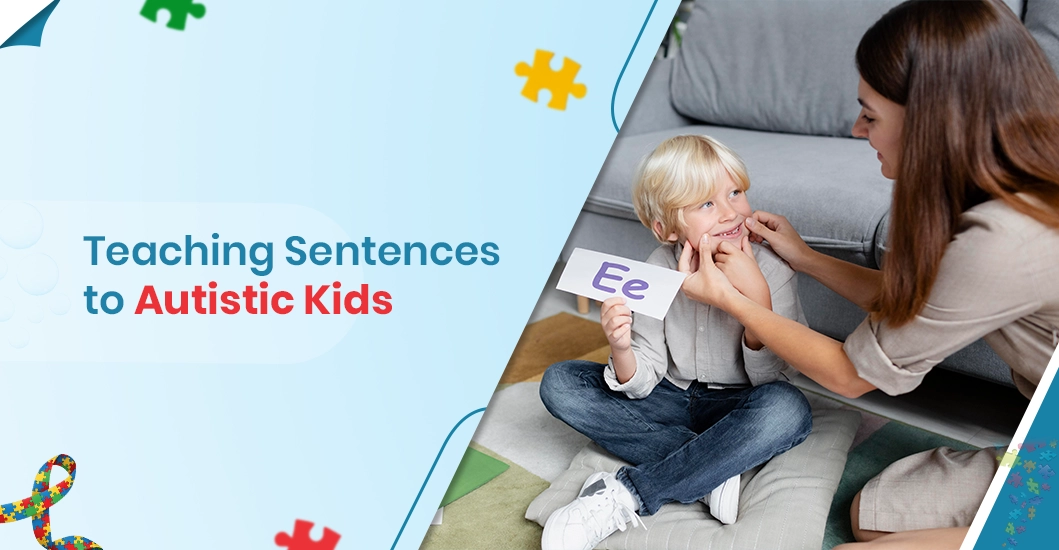
Teach sentences by building language step by step. Start with meaningful single words, then introduce two-word combinations such as “more juice” or “want toy.” Gradually expand to short sentences using modelling, visual supports, play-based activities, and everyday conversations. Progress varies for every child, and some children may communicate best using AAC devices or picture-based systems instead of spoken language.
Key Steps
- Build a strong vocabulary with meaningful single words.
- Encourage two-word combinations during daily activities.
- Model simple sentences instead of asking children to repeat.
- Use pictures, gestures, or AAC when needed.
- Practice consistently through play and daily routines.
- Celebrate every small communication milestone.
Remember: There is no fixed timeline. Some children begin using sentences within months, while others take longer. The goal is meaningful communication-not just spoken words.
Why Is Sentence Building Hard for Autistic Children?
Making a sentence look simple. But it is actually five or six skills stacked one on top of the other. And autism can affect any layer of that stack.
First, there is motor planning. This means the mouth and tongue need to move in the right order to say words clearly. Many autistic children also have apraxia, which makes this even harder.
Second, there is the “why bother” question. A child needs to feel some reason to combine words. This comes from wanting to connect with people, and that drive does not come naturally to every child.
Third, there is memory. To say “I want cookie,” a child must hold three words in mind and put them in order. That takes real mental effort.
And here is something most guides skip. Sensory overload eats up all the brain’s spare capacity. A child who feels overwhelmed by bright lights or a tight shirt tag has no energy left for grammar. You cannot teach sentence structure to a child whose body is stuck in stress mode.
This is exactly why flashcard drilling often fails. You are working on the output. But the real block sits much earlier in the chain.
When Should You Start Teaching Sentences?
Here is the honest answer. Start when single words are useful, not when they are perfect.
You do not need flawless pronunciation. You do not need fifty words in their vocabulary first. Speech therapists look for one main sign: intentional communication. This means your child points, reaches, makes a sound, or signs to get something from you. Even a rough attempt counts.
If your child says “ba” every time they mean ball, do not correct it. Build on it. Waiting for the perfect speech before adding new words is one of the biggest mistakes parents make without realizing it.
For nonverbal autism, the same rule applies but looks a little different. Once a child uses two symbols on a picture board or two signs together with clear intent, they are ready to expand. This applies whether or not they use spoken words at all.
Step-by-Step Method: From Single Words to Full Sentences
1. Pick words your child actually cares about.
Teach words linked to snacks, favourite toys, and daily routines. “Cookie” will be learned in a week. “Cat” from a random flashcard might take months.
2. Model one word more than what they use now.
If your child says “juice,” you say “want juice.” Do not say “I would like some juice please.” That is too much information at once. This idea comes from a method called LAMP, and it works because it respects how much the brain can handle at one time.
3. Wait after you model.
Count to five slowly in your head. Do not fill the silence. That pause is often where your child starts talking on their own.
4. Use simple sentence patterns.
Phrases like “I see a ___” or “I want ___” give your child a ready frame. They just need to fill in the blank with a new word each time.
5. Add to their words instead of fixing them.
If your child says “want juice,” you say “you want juice” or “want more juice.” You are showing the fuller version, not pointing out a mistake.
6. Slowly remove the support.
Once your child uses a word combo well across different places – home, school, grandma’s house – start reducing the hints and prompts you give.
Proven Techniques Parents Can Use at Home
Autism speech therapy at home does not need special equipment. It needs steady practice woven into your normal day.
• Talk through your own actions. Say things like “I am pouring water. Water is cold.” This gives your child language input with zero pressure to respond.
• Create small problems on purpose. Hand your child an empty cup instead of their juice box. That tiny confusion creates a natural chance for them to communicate.
• Use picture sentence strips. Velcro picture boards with “I want” plus a toy picture give children something solid to build a sentence with, before they can do it purely from memory.
• Read the same book again and again. Many autistic kids learn best through repetition. A predictable story gives them a safe frame to fill in words themselves.
Best Apps and Tools for Autism Sentence Building
Tools are not magic. But the right one can speed things up.
• Proloquo2Go – a strong AAC app for building sentences symbol by symbol. Widely used for nonverbal autism to sentences progress.
• TouchChat – similar to Proloquo2Go, with good customisation. This matters a lot if a device becomes your child’s main way to talk.
• Language Builder card sets – physical cards for children who learn better by touching and moving objects than by looking at a screen.
• Otsimo or Endless Reader – fun, game-based apps. Use these as extra practice, not as a replacement for talking with your child directly.
No app can replace a parent who talks through daily life with their child. Use apps as a bridge, not the main road.
How Speech Therapy Supports Sentence Development
A speech-language pathologist (SLP) can find the real reason behind the delay. Is it motor planning? Trouble understanding language? Or difficulty knowing why to communicate at all? Each of these needs a different plan, and guessing wrong wastes months of effort.
Therapists also use structured programs like LAMP or PECS (Picture Exchange Communication System) correctly and in the right order. Many well-meaning parents skip steps in PECS. And skipping steps is exactly what keeps kids stuck at “matching pictures” instead of moving on to full sentence strips.
Your job as a parent is not to replace therapy. It is to carry forward what happens in the therapy session into the other 23 hours of the day. That repeated practice is what truly builds the skill.
Tips for Parents: Dos and Don’ts
Do:
• Follow what interests your child, even if it seems unusual (yes, even if it’s just vacuum cleaners).
• Celebrate rough attempts. “Wa” for water is real progress, not something to fix right away.
• Keep your sentence models just one step ahead of your child, never three steps ahead.
Don’t:
• Keep asking test questions like “What’s this? What’s this?” It feels like an exam, not a conversation.
• Force eye contact before your child can communicate. This often shuts them down completely.
• Compare your child’s progress to a sibling’s or to a standard milestone chart. ASD language development strategies rarely follow a straight line, and they definitely do not follow a fixed schedule.
Ready to Start?
Pick just one method from this guide. Try expectant pauses, sentence frames, or narrating your day. Stick with it for two full weeks before adding anything new. Sentence building does not come from trying many things at once. It comes from steady, predictable repetition your child can trust.
If you have questions about your child’s development, we’re here to listen, understand, and guide you with care. Reach out to our team for a personalized consultation. You do not have to figure this out alone.