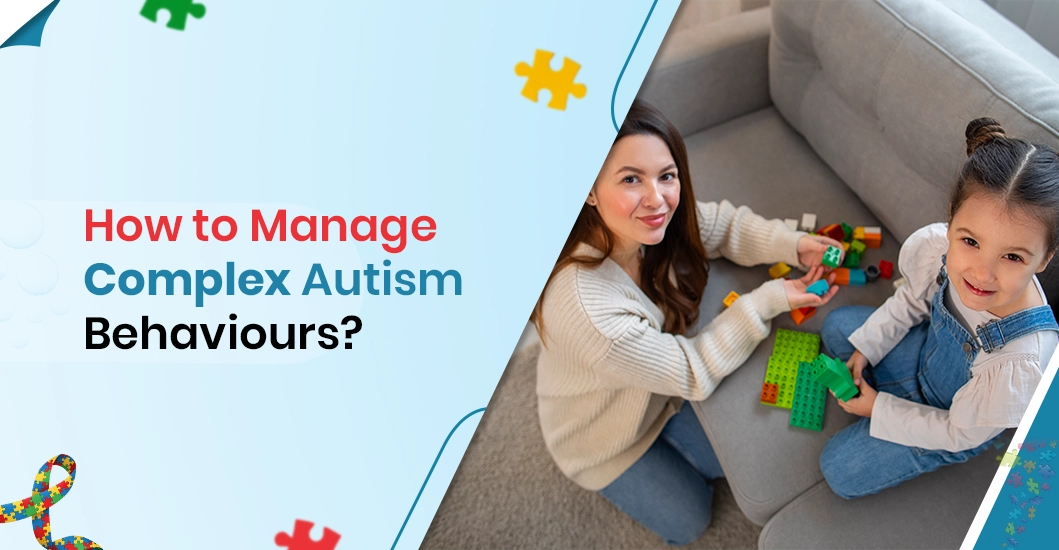
A complex behaviour program for autism is built for children and adults whose daily challenges go well beyond what a standard therapy plan can address. When autism challenging behaviour treatment becomes essential, it reflects a reality that many families in India know well: a child who is struggling in ways that are unsafe, exhausting, and poorly understood by the people around them. This guide covers complex behaviour autism support, severe autism behaviour management, autism aggression support, autism emotional regulation therapy, and what a genuinely specialised autism therapy program looks like from the inside. If you are searching for honest information about autism complex needs programs anywhere in India, this guide is written with your family in mind.
Disclaimer: This blog is intended for informational purposes only. It is not a replacement for professional medical or therapeutic advice. Please consult a licensed behaviour analyst, a developmental paediatrician, or a qualified specialist for a proper assessment and a personalised plan.
A Note Before You Read: Who This Guide Is Really For
There is a particular kind of exhaustion that comes with raising a child whose behaviours are severe. It is not the tiredness that follows a long day. It is the kind that settles into your bones over months and years of not quite finding the answers you need, of trying strategies that work for other families but not yours, of watching your child suffer and not knowing how to help.
This guide exists for those families.
It is also for teachers struggling to support a student in the classroom safely. For grandparents who want to understand. For support workers who need a clearer framework. For anyone who loves or cares for a person with autism whose behaviours have crossed into territory that feels genuinely frightening or unmanageable.
A complex behaviour program for autism is not a punishment. It is not a sign that someone has failed. It is a recognition that some individuals need a more intensive, more thoughtful, and more precisely designed level of care than a general autism therapy program provides. And across India today, that level of care is increasingly available.
Here is exactly what this guide will cover, section by section:
- What complex behaviours in autism actually are, and how they differ from the challenges most families face
- The triggers that most commonly push behaviour into crisis territory
- Why emotional dysregulation sits at the heart of so many severe behaviours
- How the inability to communicate drives aggression, self-injury, and meltdowns
- The specific therapy approaches that form the backbone of a complex behaviour program for autism
- How personalised intervention plans are built, monitored, and adjusted over time
- What families can realistically do at home to support the process
- Direct, honest answers to the questions caregivers and parents ask most often
Read through in order, or jump to the section most relevant to your situation. Either way, by the end, you will have a clearer picture of what real support looks like and how to find it.
What Are Complex Behaviours in Autism? Recognising When Standard Support Is Not Enough
Complex behaviours in autism are not simply bigger versions of the challenges most children on the spectrum experience. They are a distinct category of behaviour that is persistent, intense, and directly harmful to the individual’s quality of life, safety, and ability to participate in family and community settings.
A behaviour is typically classified as complex when it meets at least one of the following conditions:
- It results in physical injury to the child or to the people around them
- It prevents the child from accessing education, therapy, or basic daily routines
- It has continued despite consistent and appropriate use of standard behavioural strategies
- It demands constant supervision to keep everyone physically safe
- It appears to be driven by several overlapping causes that resist simple solutions
The most common complex behaviours seen in autism include:
- Severe self-injurious behaviour: This includes repeated head-banging against hard surfaces, biting the hands, wrists, or arms, scratching the skin until it bleeds, and pulling out hair in chunks. These behaviours are distressing to witness and carry real medical risk.
- Physical aggression toward others: Hitting, kicking, biting caregivers, siblings, teachers, or peers. This can range from frequent low-level contact to intense episodes that result in injury.
- Elopement: Bolting suddenly and without warning into dangerous environments such as roads, bodies of water, or crowded public spaces.
- Prolonged meltdowns: Episodes that last thirty minutes or more, do not respond to standard calming strategies, and leave both the child and the caregiver depleted.
- Pica: Consuming or mouthing non-food items such as paper, dirt, fabric, or small objects, which carries serious health consequences.
- Entrenched non-compliance: A persistent refusal of all demands and transitions that effectively blocks the child from participating in any structured activity.
The single most important shift a family can make is to stop seeing these behaviours as deliberate defiance and to start seeing them as signals. Every behaviour has a function. Every behaviour is trying to communicate something. A complex behaviour program for autism is built on that understanding.
Common Triggers for Complex Behaviours: Understanding What Sets Things Off
Severe autism behaviour management begins not with strategies but with understanding. Before any intervention is implemented, the therapy team needs to know what is triggering the behaviour in the first place. Behaviours that appear sudden or unprovoked almost always have an identifiable cause when they are observed carefully and over time.
Sensory Triggers
The sensory environment is one of the most frequent sources of behavioural escalation in autism. Many individuals with autism have a nervous system that processes sensory input in a heightened or distorted way. Fluorescent lighting, background noise in a classroom, the seam of a sock, the smell of a particular cleaning product, or the sensation of a crowded bus can all create genuine physical distress. When that distress has no other outlet, behaviour becomes the outlet.
Environmental and Routine Triggers
Unpredictability is difficult for most people. For many individuals with autism, it is intolerable. Sudden changes to routine, unfamiliar environments, transitions between activities without adequate warning, and situations where expectations are unclear can all push a child toward a behavioural crisis very quickly.
Physical and Medical Triggers
This category is frequently missed. Pain that cannot be communicated verbally, chronic constipation, toothache, ear infections, headaches, sleep deprivation, hunger, and the side effects of medications can all dramatically increase the frequency and intensity of challenging behaviours. A child who cannot say “my stomach hurts” may show it instead by hitting, crying, or refusing all food.
Social and Emotional Triggers
Being misunderstood, feeling ignored, having a need denied without explanation, or experiencing social conflict can all generate intense emotional distress. For a child with limited capacity to regulate that distress internally, the result is often a behavioural response that looks aggressive or extreme but is, at its core, an emotional flood with no other exit.
A thorough autism complex needs program always begins with a structured trigger assessment. Without that foundation, even the best strategies are unlikely to produce lasting change.
Autism Emotional Regulation Therapy: Why Dysregulation Is at the Centre of Everything
Autism emotional regulation therapy addresses the neurological reality that many individuals with autism experience emotions more intensely and have less access to the internal braking system that helps most people manage those emotions before they overflow into behaviour.
This is not a parenting failure. It is not a personality problem. It is a real, measurable, and treatable neurological difference.
Signs that emotional dysregulation is driving the behaviour include:
- The child escalates from calm to crisis in what feels like seconds, with very little visible warning
- Once escalated, the child cannot be reached through words, comfort, or redirection for a prolonged period
- Emotional responses appear far bigger than the situation seems to warrant
- The child has multiple distress episodes in a single day, with little recovery time in between
- Attempts to comfort or redirect during a meltdown make the behaviour worse, not better
Autism emotional regulation therapy works by gradually building the child’s capacity to notice emotional states earlier, before they reach the point of no return, and to use specific tools that bring the nervous system back to a manageable state. This involves close work with a trusted adult as a co-regulator, sensory-based calming strategies, visual tools like emotion scales and feelings charts, and carefully managed exposure to tolerable levels of difficulty.
This is slow, careful work. Families should expect the process to unfold over months rather than weeks. But when the program is right for the child and the team is consistent, the outcomes are often transformative.
Communication Barriers and Autism Aggression Support: The Link That Changes Everything
The majority of autism aggression in children with complex needs is directly connected to an inability to communicate. This is the insight that changes the way most families understand the behaviour they are living with.
When a child cannot say “I am scared,” “this hurts,” “I need a break,” “I do not understand what you are asking,” or “I am overwhelmed,” the body finds another way to send that message. Hitting communicates. Biting communicates. Screaming and throwing communicate. These behaviours work, which is exactly why they continue.
Therefore, support for autism aggression must include a communication component. Without it, reducing the behaviour without addressing its function simply displaces it elsewhere.
Strategies used to address communication barriers in complex behaviour programs:
- Functional Communication Training (FCT): The child is taught a specific, simple, and reliable way to communicate the need that is currently being expressed through the challenging behaviour. The replacement communication must be easier and faster to use than the behaviour, or the child will not switch.
- AAC implementation: Speech-generating devices, tablet-based apps, and picture-based systems provide nonverbal and minimally verbal individuals with a consistent, dignified communication channel.
- Simplifying demands temporarily: While new communication skills are being built, the language and expectations directed at the child are often reduced to lower the overall communication load.
- Training the whole environment: Every adult who regularly interacts with the child, including parents, grandparents, teachers, and domestic help, needs to recognise and respond to the child’s communication attempts consistently.
When a child learns that pressing a symbol on a device or handing over a card yields a faster, more reliable result than hitting, the aggression loses its purpose. This shift takes time, but it is among the most durable changes that specialised autism therapy can produce.
Therapy Approaches Used in a Complex Behaviour Program for Autism
A quality complex behaviour program for autism does not rely on a single method. It draws on several evidence-based frameworks, selecting and combining approaches tailored to the individual child’s profile.
Applied Behaviour Analysis (ABA): The most researched framework in autism challenging behaviour treatment. ABA systematically identifies the function of a behaviour and builds a targeted intervention to address that function and teach a replacement skill.
Positive Behaviour Support (PBS): A person-centred approach that focuses on changing the environment, routines, and communication systems to reduce the need for challenging behaviour in the first place. PBS looks at the whole life of the individual rather than isolated behaviours.
Sensory Integration Therapy: Delivered by occupational therapists, this approach addresses differences in the nervous system’s processing. It builds tolerance, improves sensory regulation, and reduces the frequency of sensory-triggered behaviours over time.
Trauma-Informed Practice: Some individuals with complex needs have a history of distressing experiences, including poorly managed physical interventions, repeated failure, or social exclusion. A trauma-informed approach shapes all interactions with an awareness of this history and avoids re-traumatisation.
Collaborative Problem Solving (CPS): This approach identifies the specific skill gaps that make certain situations consistently difficult and, where possible, collaboratively works with the child to find solutions. It treats the child as a participant in their own care rather than a subject of it.
Reputable specialised autism therapy centres across India combine these approaches within a coordinated multidisciplinary team, so that behaviour, communication, sensory, emotional, and family needs are addressed together rather than in isolation.
Personalised Intervention Plans: How a Complex Behaviour Program Is Built Step by Step
A complex behaviour program for autism does not begin with strategies. It begins with questions. What exactly is happening? When? Where? With whom? What usually comes before the behaviour? What usually follows it? What has been tried, and what happened?
Only when those questions are answered thoroughly can a meaningful plan be built.
The process of building a personalised intervention plan typically involves:
Step 1: Functional Behaviour Assessment (FBA) This is a structured, data-driven process of observing and recording behaviour over time to identify its function. Is the child using the behaviour to escape a demand? To access something they want? To gain attention? To communicate physical pain or internal discomfort? The function determines the intervention.
Step 2: Ecological Assessment A review of every environment the child regularly inhabits, including the home, school, therapy setting, and community spaces. This identifies what in those environments is contributing to, or maintaining, the behaviour.
Step 3: Communication and Skills Assessment An evaluation of what communication tools the child currently uses, how effectively they work, and what skill gaps exist that are relevant to the behaviour.
Step 4: Behaviour Intervention Plan (BIP) A clearly written document that specifies the strategies to be used, how each adult in the child’s life should respond to the behaviour and to replacement skills, and what teaching goals are in place. A good BIP is specific, readable, and usable by everyone involved in the child’s care.
Step 5: Ongoing Data Collection and Plan Review. The plan is not written once and filed away. Progress is tracked through regular data collection, and the plan is reviewed and adjusted at agreed intervals as the child grows and goals evolve.
Families working with quality autism complex needs programs across India should be active participants in every one of these steps, not passive recipients of a plan designed without their input.
Family Support Strategies: What You Can Do at Home That Actually Helps
Severe autism behaviour management at home is genuinely hard. Clinic-based strategies do not always translate easily into a busy household with other children, work pressures, and extended family dynamics. That is precisely why family support is not an afterthought in a quality complex behaviour program for autism. It is a pillar of the program itself.
Practical strategies that make a real difference:
Manage your own nervous system first. Children with autism are acutely sensitive to the emotional state of the adults in their environment. When a caregiver is panicked, tense, or angry during a meltdown, the child’s escalation almost always increases. This is not a criticism. It is a physiological reality. Learning to regulate your own response is one of the most powerful tools available to a parent.
Lower the demand load during difficult periods. When a child is already stretched to their limit, adding more demands, however reasonable they may seem, accelerates escalation. Simplify the environment. Reduce instructions to single steps. Give more time. Give more space.
Communicate in a way the child can actually process: short sentences, a calm tone, familiar words, and visual supports alongside speech. Many children with complex needs are processing language more slowly than it appears, especially when they are dysregulated. Less is consistently more.
Apply the behaviour plan the same way every time. Inconsistency is one of the most common reasons behaviour plans produce slower results than expected. When one parent responds one way, and another responds differently, the child receives conflicting information, and the behaviour is inadvertently reinforced by unpredictability.
Keep a simple behaviour record. A brief daily note on what happened before, during, and after each difficult episode provides the therapy team with invaluable information to refine the intervention plan. It does not need to be elaborate. A few lines are enough.
Take your own well-being seriously. Caregiver burnout is not a weakness. It is what happens when a person gives everything they have for a prolonged period without adequate support. Joining a parent group, accepting respite when it is available, and speaking honestly to your own doctor about your stress levels are not indulgences. They are necessary.
Many autism complex-needs programs across India now include caregiver training, sibling support, and family counselling as part of the overall package. These elements exist because the research is detailed: when the whole family is supported, the child makes faster and more sustained progress.
Moving Forward: The Right Support Changes Everything
A complex behaviour program for autism does something that standard support simply cannot do for every child. It goes deeper. It asks harder questions. It builds more precisely around the individual. And when it is implemented well, with a skilled team, an honest assessment, and a family that is genuinely included in the process, it changes lives.
The behaviours your child is showing are not a reflection of their character, their intelligence, or your parenting. They are a signal that something is not working and that a different kind of support is needed. Recognising that and acting on it is not giving up. It is exactly the right thing to do.
Across India, families are finding the right level of specialised autism therapy through dedicated centres, trained behaviour analysts, and programs built for children with the most complex needs. You do not have to figure this out alone.
Book your consultation today and start your journey toward a safer, calmer, and more connected life for your child and your family.
Medical Disclaimer: The content in this blog is for educational and informational purposes only. It does not constitute medical advice, a clinical diagnosis, or a treatment recommendation. Please consult a qualified healthcare professional, licensed behaviour analyst, or developmental specialist for personalised guidance regarding your child’s specific needs and circumstances.